tried to write book 2 first. In my defense, it made sense at the time. I was working on a dark fantasy romance series at the time. Think Breaking Bad meets Harry Potter. The series had concurrent timelines across the first three books. Same events, different POVs, everything weaving together. The middle book was supposed to be the lynchpin. Hammer that sucker in and everything would fall into place.
Hallucinations of the Sun
The series is called Domains of Power. When I started in June of 2024, it was four books. A nice contained story about magical universities, ancient conspiracies, ... drugs, and kids dealing with problems way above their pay grade.
Simple.
Easy, even.
Then I told someone the ending.
"So they just ... end up in hell?"
Yes! A fitting ending... so dark... grim...People hated it, and perhaps they were right. I went back to the drawing board and behold, book 5 was born.
Somewhere during the process of outlining book 5, I realized oh, there's seven hundred years of history here. Secret societies. Cults. Immortals pulling strings since 1050. I had to explain the lore.
Book 6.
And then, somewhere around 2am, staring at my notes: wait. What if [REDACTED] had a son? And what if he was [REDACTED]??
Oh no.Book 7.
I fought every single addition. Lost every single fight. The story kept demanding more, and I kept saying yes. Because "yes and" is much better than "no" or "but."
"I started with 4 books and lost every fight."
Pulling Back the Curtain
Here's what this series actually looks like:
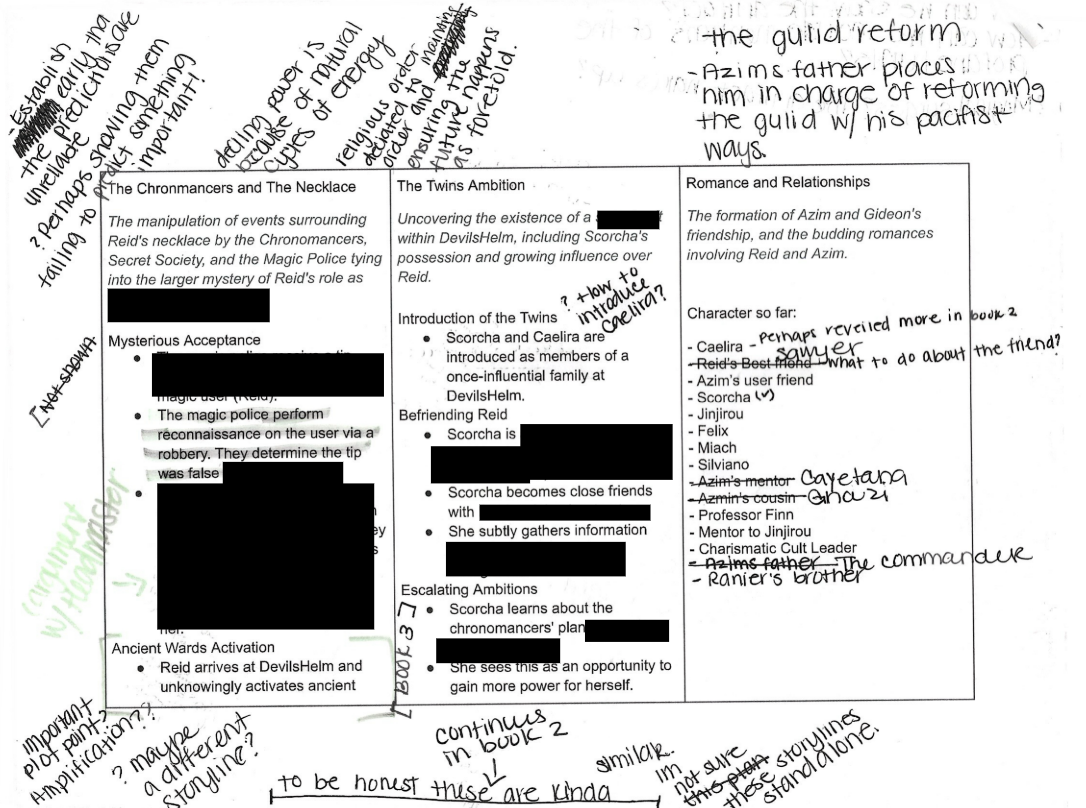
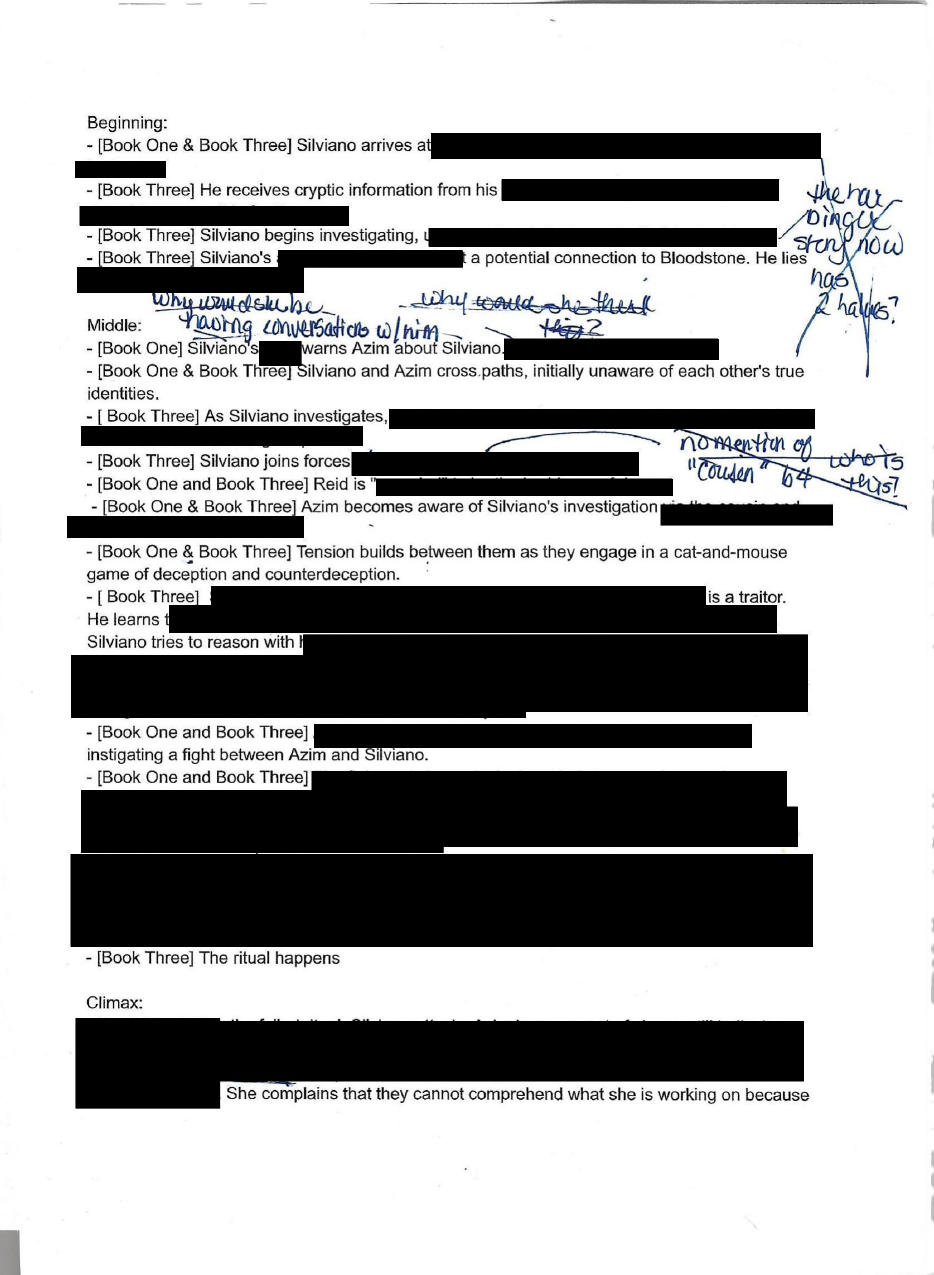
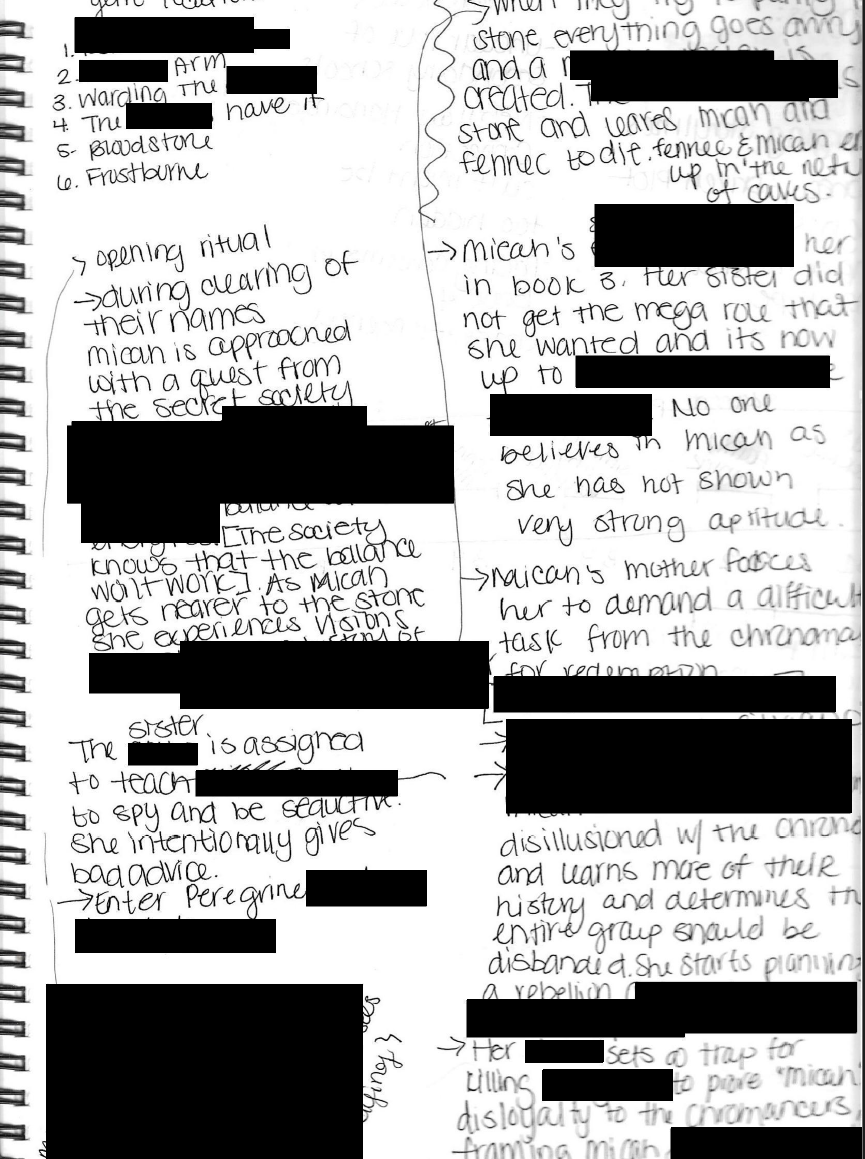
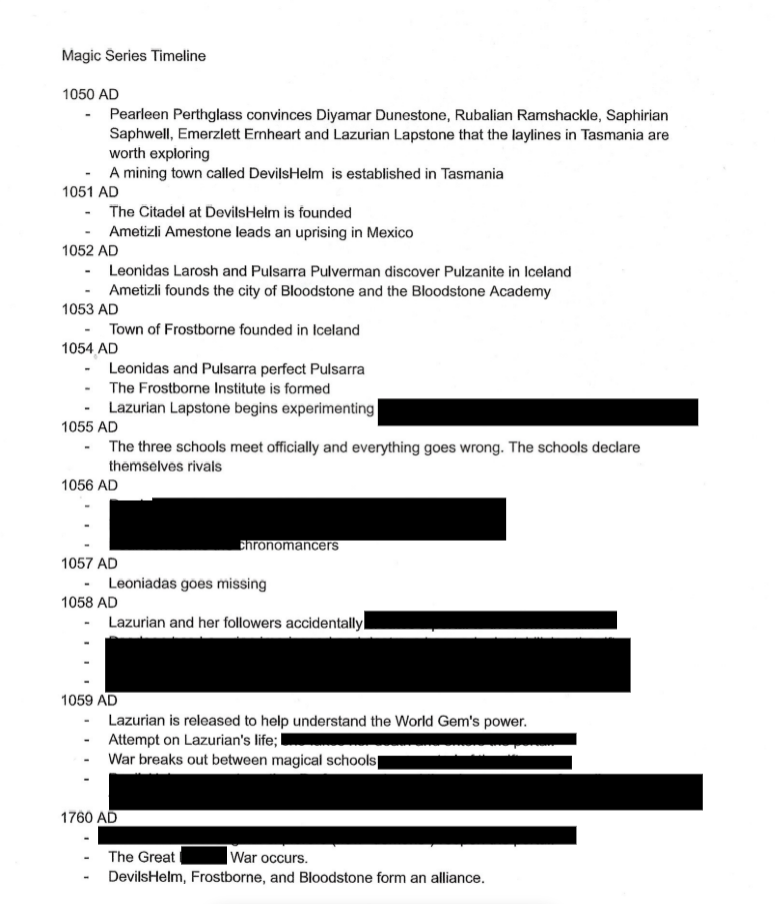
Six magical domains tied to ancient artifacts. Three schools with different political ideologies. Multiple POV characters each carrying their own arcs across books. Investigations, awakenings, research projects, revenge plots, cult machinations, political reform, drug conspiracies. Prophecies that might be manipulated. Timelines that overlap. Secrets on top of secrets.
It's a lot.
I had spreadsheets. Color-coded Google Docs. A 97-page story bible. Notes scrawled in margins. And still, I'd write a scene where someone references chapter 47 and realize I'd contradicted it in chapter 63.
The information was there. Technically.
But I couldn't see it.
The Breaking Point
September 2025. I was twenty chapters from the end of book 1.
Twenty chapters. I could practically taste the finish line.
Then I realized Torvyn wasn't going to land.
Torvyn is a little punk ass from Frostborne with delusions of grandeur, a misfit gang, and not much else to back it up. He's also the main character of book 2. His rivalry with Azim is supposed to carry an entire novel.
But when I looked at what I'd actually written in book 1? The setup, the seeding, the moments that would make readers care?
Not there.
His ending felt flat because I hadn't set him up. You can't have a proper rivalry if one of them isn't on screen.
My heart sank.Crumbled, really.
Thought about putting my hard drive out of its misery to be honest. But I took a little nap and got it together.
I spent the following weeks going back through the manuscript. Ctrl+F. Rereading chapters. Taking notes on when he appeared, what he said, what readers would know about him by this point. Cross-referencing with my spreadsheet, my outline, my notes.
The whole time I kept thinking: there has to be a better way.
Because here's the thing about my book. It's a lot about what is not said. The secrets characters keep. The information readers have that characters don't. The gaps between what's happening in one timeline and what's happening in another.
"No tool I tried could show me the silence and the shape at the same time."
The tools I tried: Google Sheets, Miro, Google Docs, Novelcrafter, Autocrit, Scrivener, Ellipsis, Living Writer, Sudowrite.
They all did something different. Editing. Organizing. Just writing.
But none of them let me see my story.The shape of it. The gaps. Where a character disappeared for 30 chapters. Where a plotline had three beats when it needed seven.
The Deity Better Known as the Fridge
I didn't have a whiteboard.
I needed to explain the problem to someone, to think through what a solution might look like. So I grabbed a dry-erase marker and started drawing on my refrigerator.
As one does.
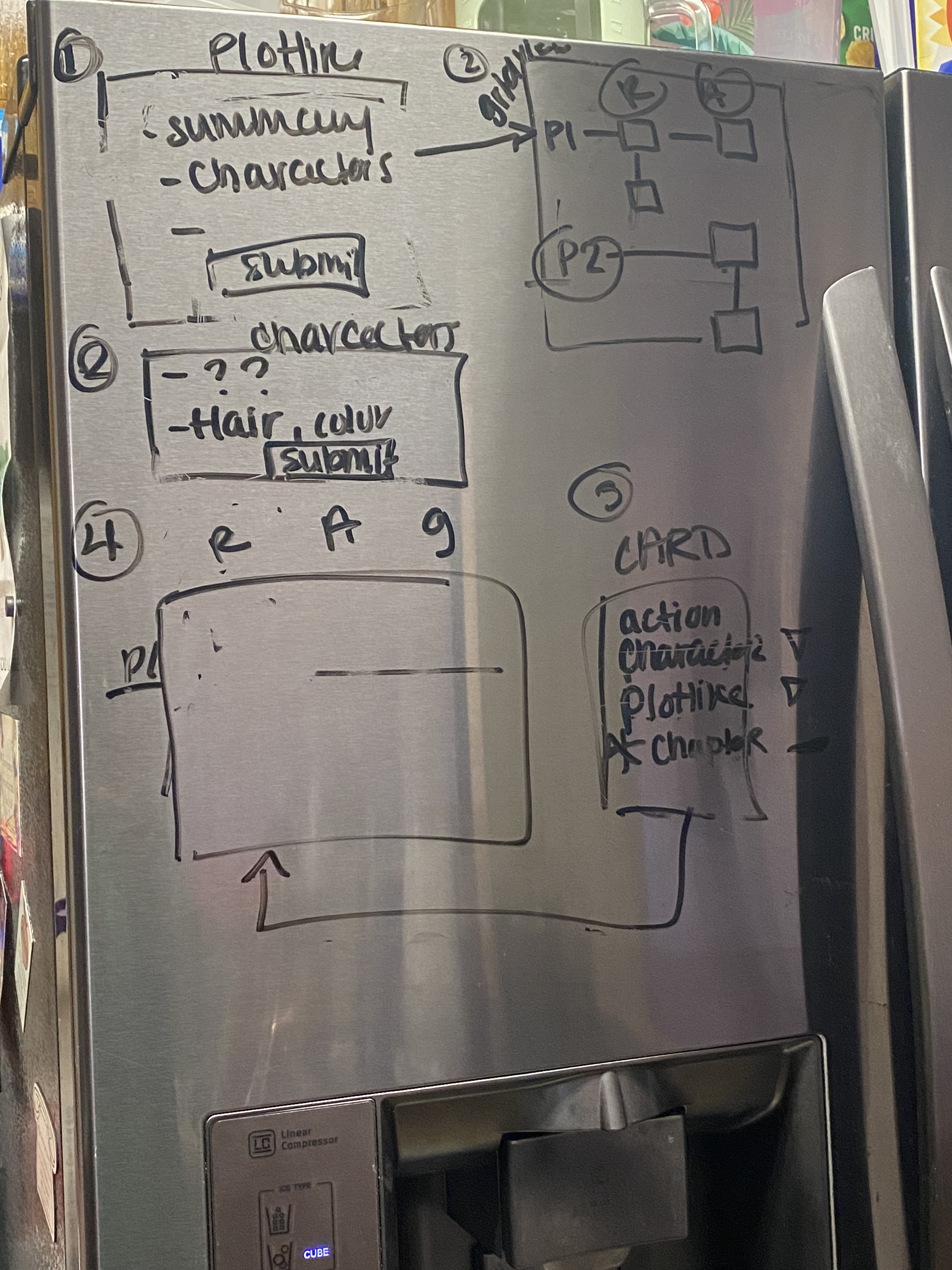
MID AFTERNOON DELUSIONS
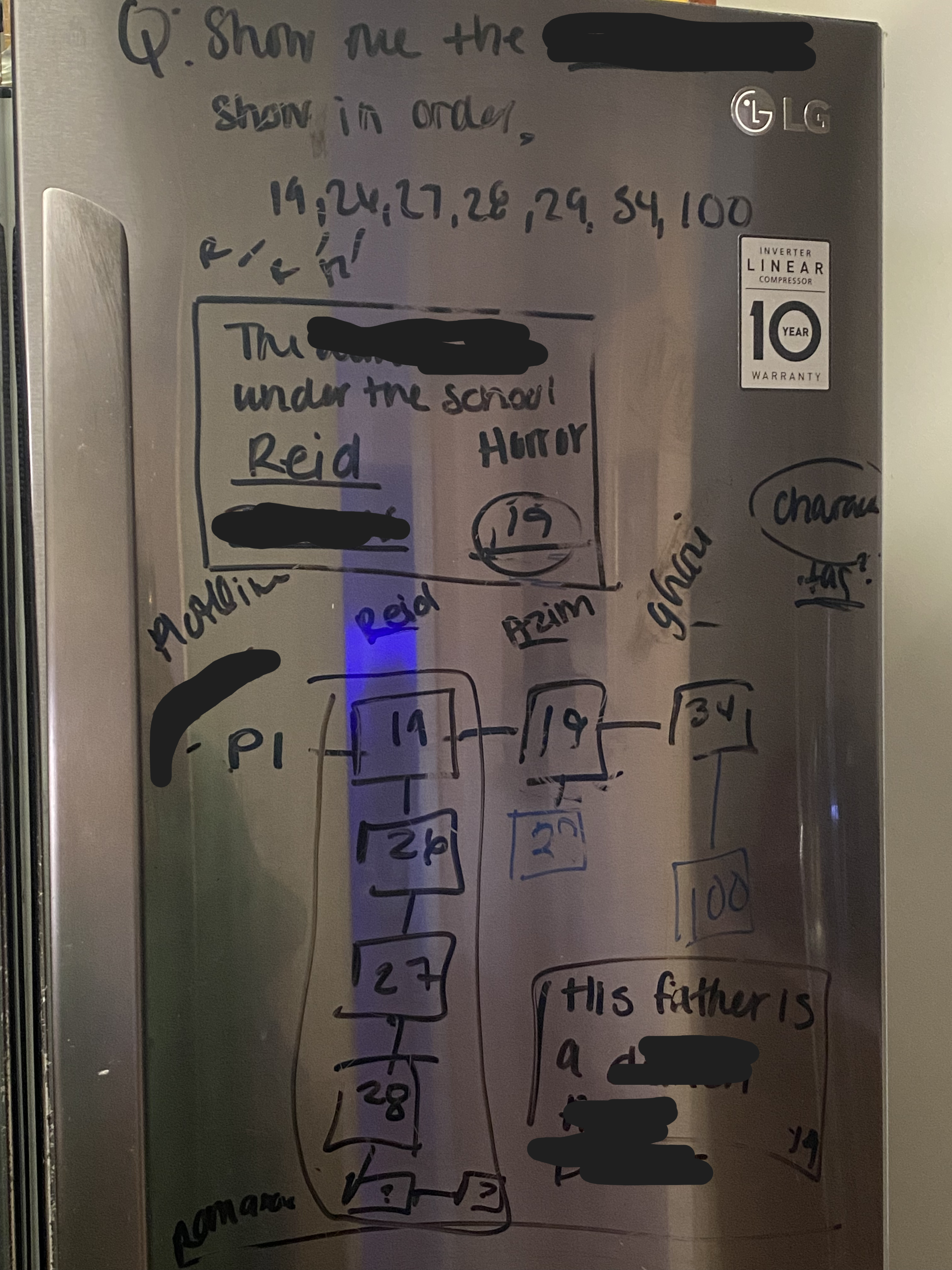
THE GOLDEN GOOSE
The second sketch is the one that mattered.
I wrote out a question: "Show me [redacted] plotline. In order." Then I drew what the answer might look like. Cards with chapter numbers. Tags for characters and themes. A visual flow showing how a thread wove through the manuscript.
That's when it clicked.
I didn't need a canvas for planning new stories. I didn't need a prettier way to organize chapters. I needed a way to ask questions of a story that already existed. To see the shape. To find the silence.
If I'd had that, I wouldn't have been in this situation. I would have seen that Torvyn's arc was underdeveloped. I would have caught it at chapter 13 instead of chapter 44.
What I'm Building
I'm calling it aampersand.
It's a writing tool for people who attempt stupid, ambitious things. The seven-book series no agent asked for. Authors writing worlds that need their own wiki. The story with so many threads you can't hold them all in your head.
The thing you probably shouldn't pursue but are going to anyway.It's early. The foundation is there. The writing environment, chapter and scene management, the beginnings of a system that lets you tag and trace your story.
But I'm building toward something bigger. A way to see your story. To experiment fearlessly. To catch the gaps before they become problems.
This devlog is my way of building in public. Each month, I'll share what I'm working on, what problems I'm solving, and what I'm learning.
Because here's the thing about Icarus.
The moral is: if you're going to fly that high, you need sunscreen.
And if no one's made it yet?
Get to mixing sunshine.let's keep in touch
I'm building aampersand for writers who dare to dream big. For the people who add too many tropes. The crossover that only makes sense to you. The world that needed its own wiki before chapter one. Let's fly together.
Next month: Finding your way in a labyrinth — how tagging becomes structure.