urns out, outlines are actually useless. In their defense, they work if you stick to them and never change. But if you've ever written a story, then you know… characters often have a mind of their own. Villains become heroes, patsies escape death, and sidekicks just sometimes quit. The hero apparently had too many daddy issues.
I tried an outline. Several, in fact. Books one, two, and three of my fantasy series happen concurrently. Three characters, three locations, overlapping timelines. What one character knows, another doesn't.
It's a magic trick. Recontextualization. You read Book One and think a character is a villain. You read Book Two, get their POV, and realize they were actually trying to save everyone.
Simple. Easy. Fun.
Then I actually looked at Book One.
I needed that pesky character from Book Two to hit specific emotional highs. But for that recontextualization to land, the groundwork had to exist in Book One. I checked my color-coded spreadsheets. The spreadsheet said:
Chapter 10 — Foreshadowing occurs.I checked my book. The foreshadowing did not, in fact, occur.
M*therfucker.Finding the missing beat wasn't the hard part. The hard part was realizing I had to go back into a 120,000-word labyrinth, pick up a lost plot thread, throw it into a completely different area of the book, and somehow make it land — without getting eaten by a mancow.
The Craft Store Solution
Writing a massive book feels exactly like being lost in a labyrinth. You can't see the shape of the maze from inside it. You can only see the hallway you're standing in.
Mythology always makes the solution sound grander than it is. A legendary thread. A divine gift from a princess. But when you're actually in the trenches of engineering a writing system, you realize that life-saving thread isn't a magical artifact. It's just a spool of red yarn you pick up in Aisle Eight of the craft store.
The power was never in the string itself. It's in the act of domestication — taking a terrifyingly complex narrative problem and solving it with a deliberately simple, repetitive action.
In aampersand, we call it tagging.
Throwing the Yarn
Here is what I wanted: to never look at a spreadsheet again.
I didn't want to leave my book to log a data point in a separate window. I didn't want to update a Google Sheet every time I planted a clue. I wanted to drop the thread right where I was standing, while I was still writing, without breaking stride.
So I went back to the scene with the missing foreshadowing. I rewrote the paragraph. And this time, I highlighted the line — “Some sacrifices have to be made without full understanding of the stakes” — and clicked Quick Tag.
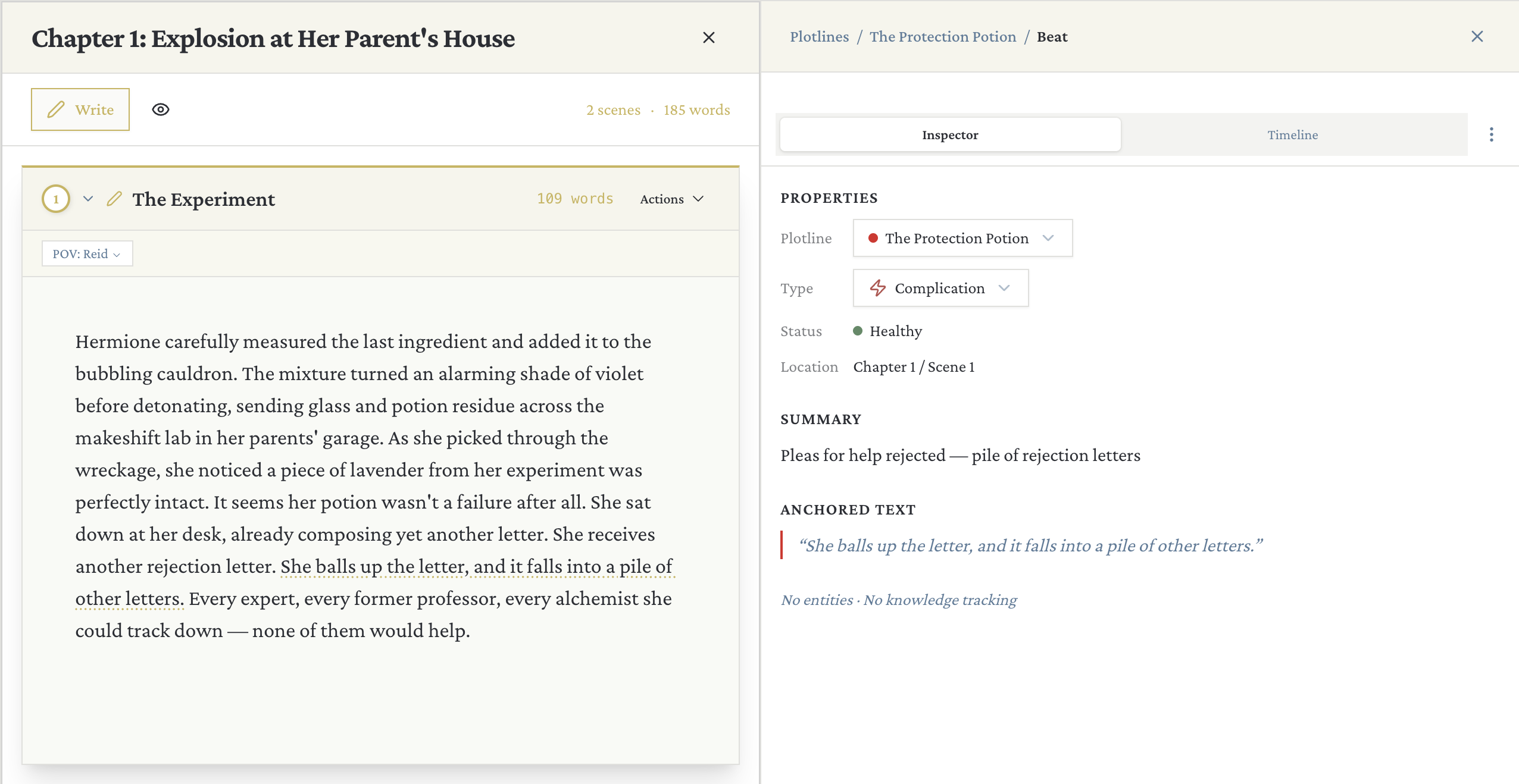
A small form appeared. I assigned it to the recontextualization plotline. Labeled it a complication. Wrote a one-line summary: Plants doubt about Silviano's motives.
A subtle colored underline appeared beneath the text.
“Two clicks and a sentence. Thread dropped.”
One tag in isolation is just a piece of string on the ground. But I kept writing. Kept tagging. A revelation in Chapter 14. A setup in Chapter 3 I'd almost forgotten about. A promise made in the prologue that I needed to pay off by Chapter 20.
I kept walking through the labyrinth, dropping yarn as I went.
Seeing the Maze
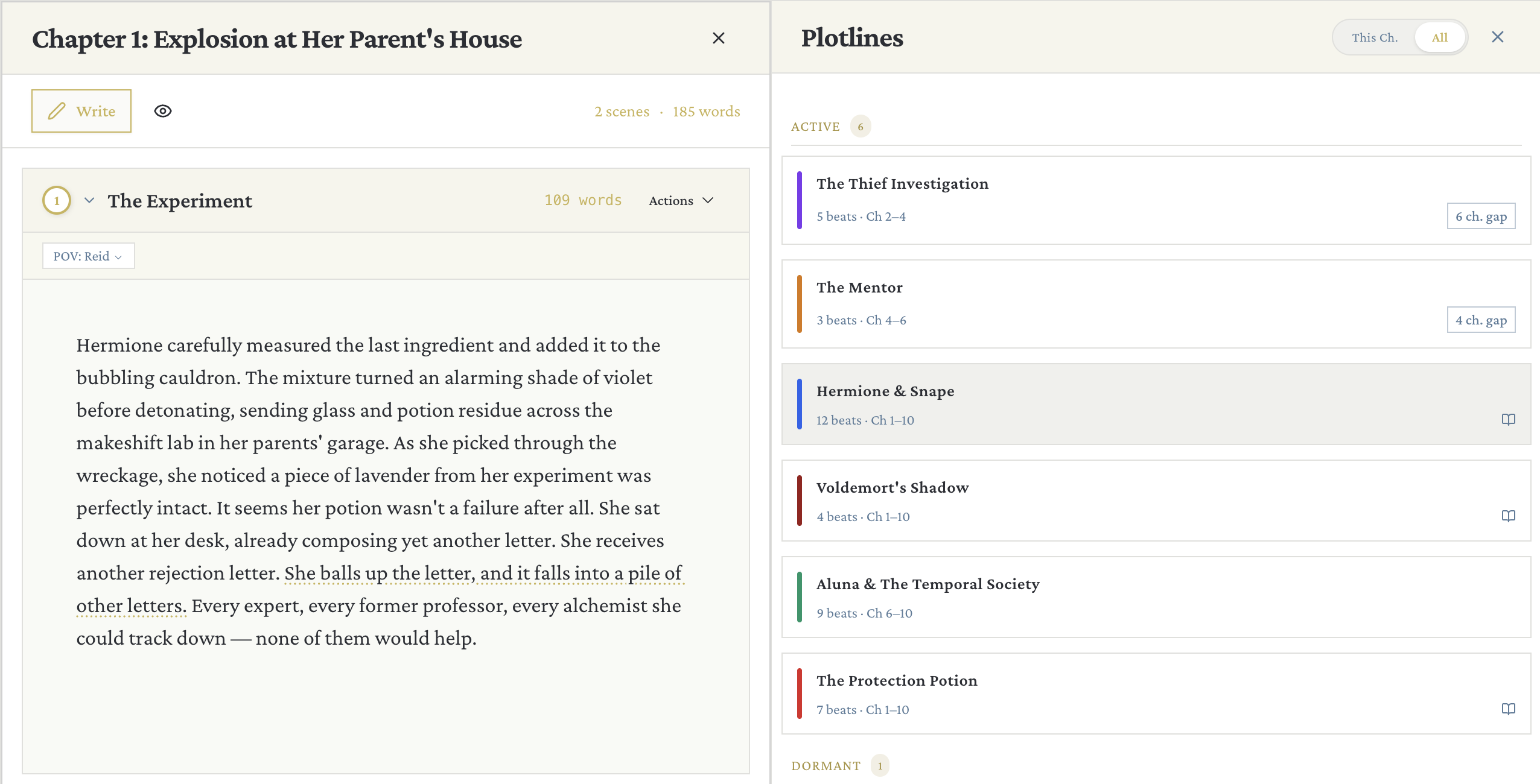
Three days later, I clicked on one of those tagged lines and opened the Plotlines Panel.
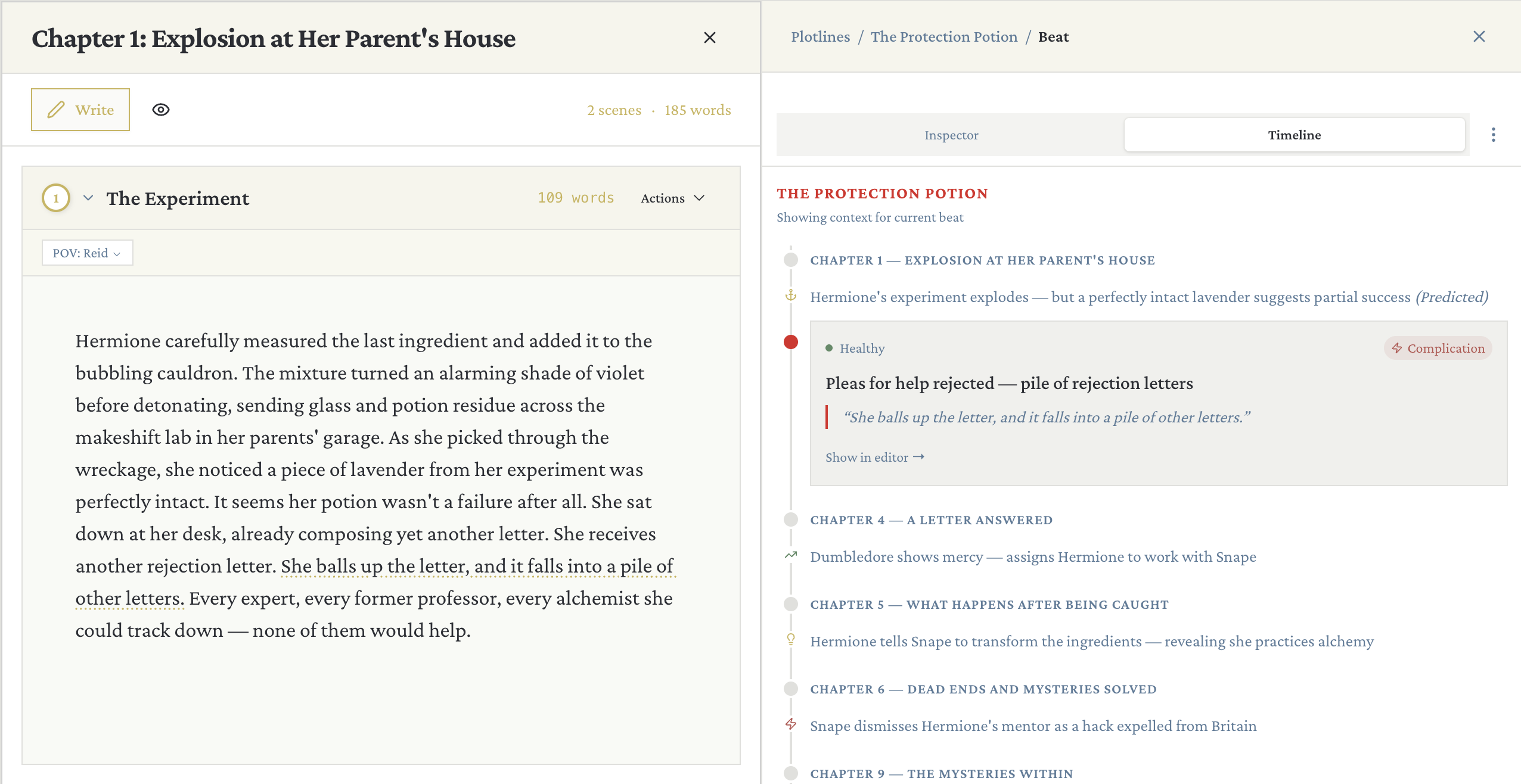
And for the first time, I stepped outside the labyrinth.Every beat of the recontextualization plotline was stacked chronologically — Chapter 1 through Chapter 44. I could see the arc: where I'd planted setups, where the complications escalated, where the revelations hit. I could see that I'd gone six chapters without touching it. I could see another plotline with only three beats total, dangerously thin, stretched across thirty chapters of silence.
This is what the spreadsheet was supposed to do. But the spreadsheet was always a step removed — a secondhand record of what I thought I'd written. The tags lived in the manuscript. They were tethered to the actual words. When I clicked a beat in the panel, it jumped me straight to the sentence.
I wasn't guessing anymore. I could see.
Cutting the Thread
But here's the thing about writing: it's an act of destruction as much as creation. You rewrite. You cut. You realize a scene isn't working and you torch the whole paragraph.
What happens to the thread when you burn the hallway it's sitting in?
In a spreadsheet, nothing. The entry stays, cheerfully lying to you. Yes, that character is still alive. No, they aren't you dingus.
In most writing software, the annotation dies with the text. Delete the paragraph, lose the note. The tool helps you forget.
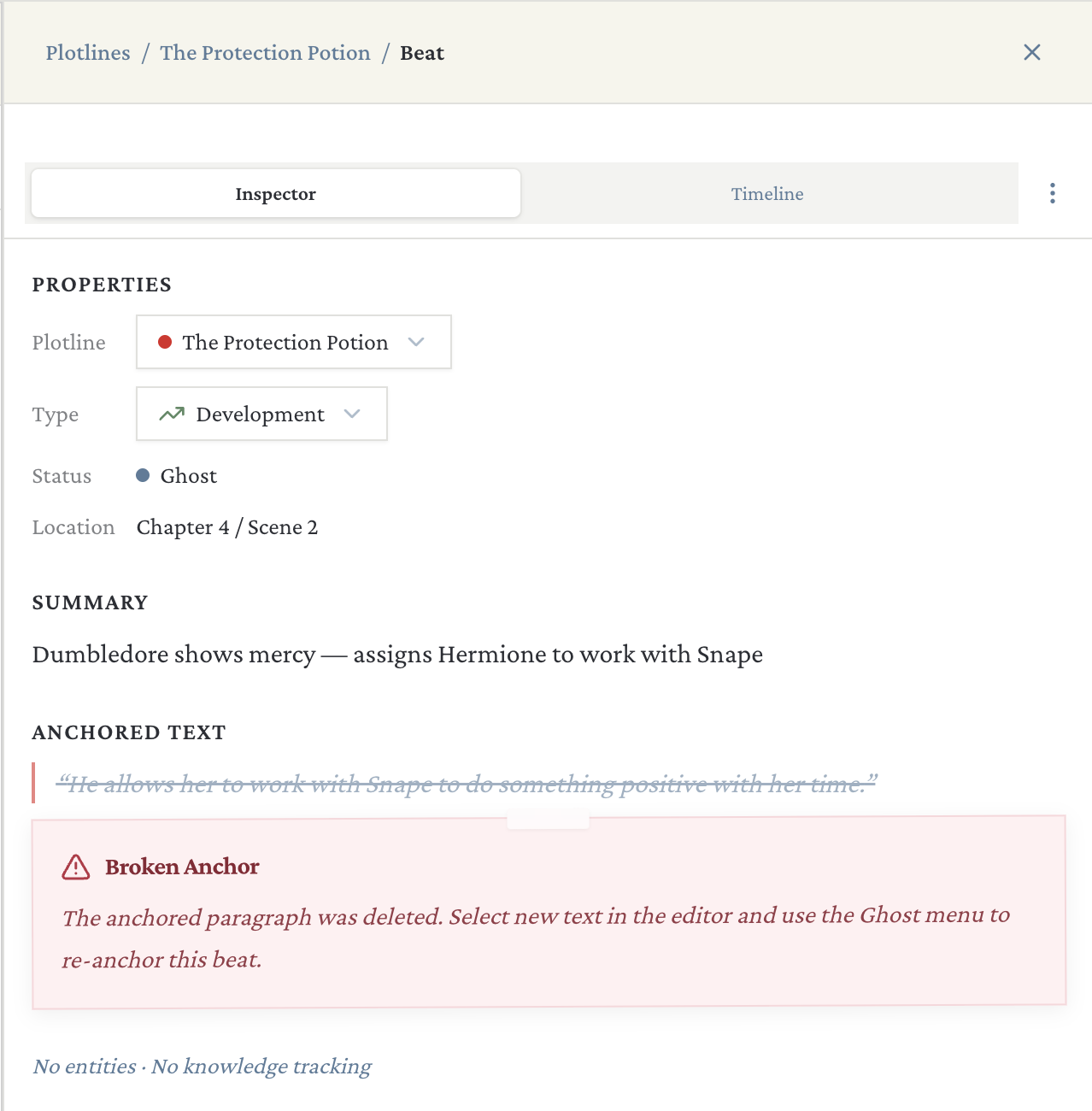
In aampersand, the thread doesn't dissolve when you cut the fabric.I deleted a paragraph. I'm prone to doing this. The beat I'd tagged in it didn't disappear. It turned into what we call a Ghost. The panel surfaced it immediately: “Hey. You said this complication was crucial for the Temporal Society plotline. The text is gone. Do you want to anchor this beat somewhere else, or is it done?”
The thread remembered what I'd said mattered, even after I destroyed the evidence.
“An annotation is a comment on the text. A beat is a claim about the story.”
That's the line between annotation and structure. An annotation is a comment on the text. A beat is a claim about the story. The text can change. The claim survives until you decide it shouldn't.
Still Walking
It's still early. We have a little more of a foundation now. I made good on my promise — you can start to see your story. But we have a long way to go.
As always, this devlog is my way of building in public. Each month, I'll share what I'm working on, what problems I'm solving, and what I'm learning.
Here's the thing about Ariadne: she gave Theseus the thread, and it saved his life. But she was only one thread in a tapestry of stories. If we're going to see the shapes of ours, we have to keep walking into the labyrinth.
Or better yet — we have to become the architects of the labyrinth itself.nothing gets left behind
I'm building aampersand for writers who remember too much — and not enough. So we can keep the eye colors straight. So the murder weapons make it to the right crime scene. Drop your email, and let's make sure nothing slips through.
Next month: Designing the labyrinth.