spent much of March confused. I am a plotter, but I am also a pantser. A rare breed of 50:50. I have a seven book fantasy series with timelines that loop, connect, cross and rewind, but the actual execution is vibes and a raunchy good time. I write the chapters that feel good and the outline is the north star. Because I live in the middle, building a feature about fusing those two brains into one should have been easy.
I spent hours interviewing other writers, watching planning videos (people really love to use Harry Potter as a way to teach planning), trying to understand people who sit firmly on both sides. This feature was to be a synthesis. I wasn't going to force choice, it was going to be different. Let the story data flow in from both sides. Planners could build structure first. Discovery writers could write, tag as they go, and the feature would reveal the structure they vibed into existence.
What came from this experience was a four level system called Lab. A freeform spatial canvas, down through scene design (name pending), into a linear timeline I call the Clothesline, and finally into a traditional outline. I think it's genuinely good. But it ate most of my month.
And then reality arrived. In May, this software goes into the hands of real writers for the first time.
A Wild Cow Appears
A hard deadline changes the math on everything. I had a comfortable, well-scaffolded roadmap. It evaporated. When real people are about to use your tool, the designs you want become suggestions. Features you'd scheduled for “later” become “now.” It's still a solo project on nights and weekends, but May put it in a different ring entirely. Under that pressure, I scoped down to the Clothesline and built it.
To test it, I loaded the first six chapters of A Profane Awakening.
Reading your own year-old prose after banging your head against the wall for a month is its own kind of torture. You are never the writer you were when you started the story. But I pushed through the cringe, tagged my beats, and opened the Lab.
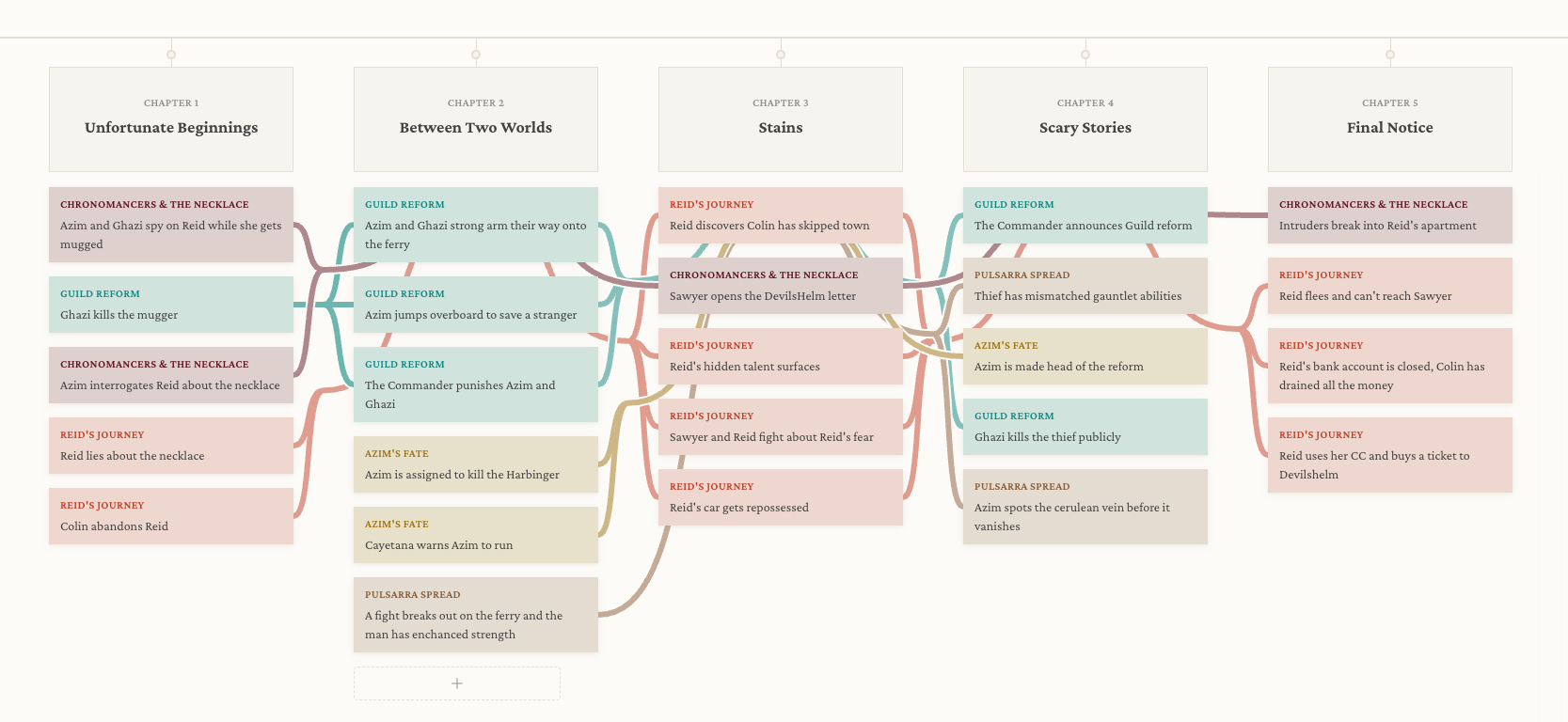
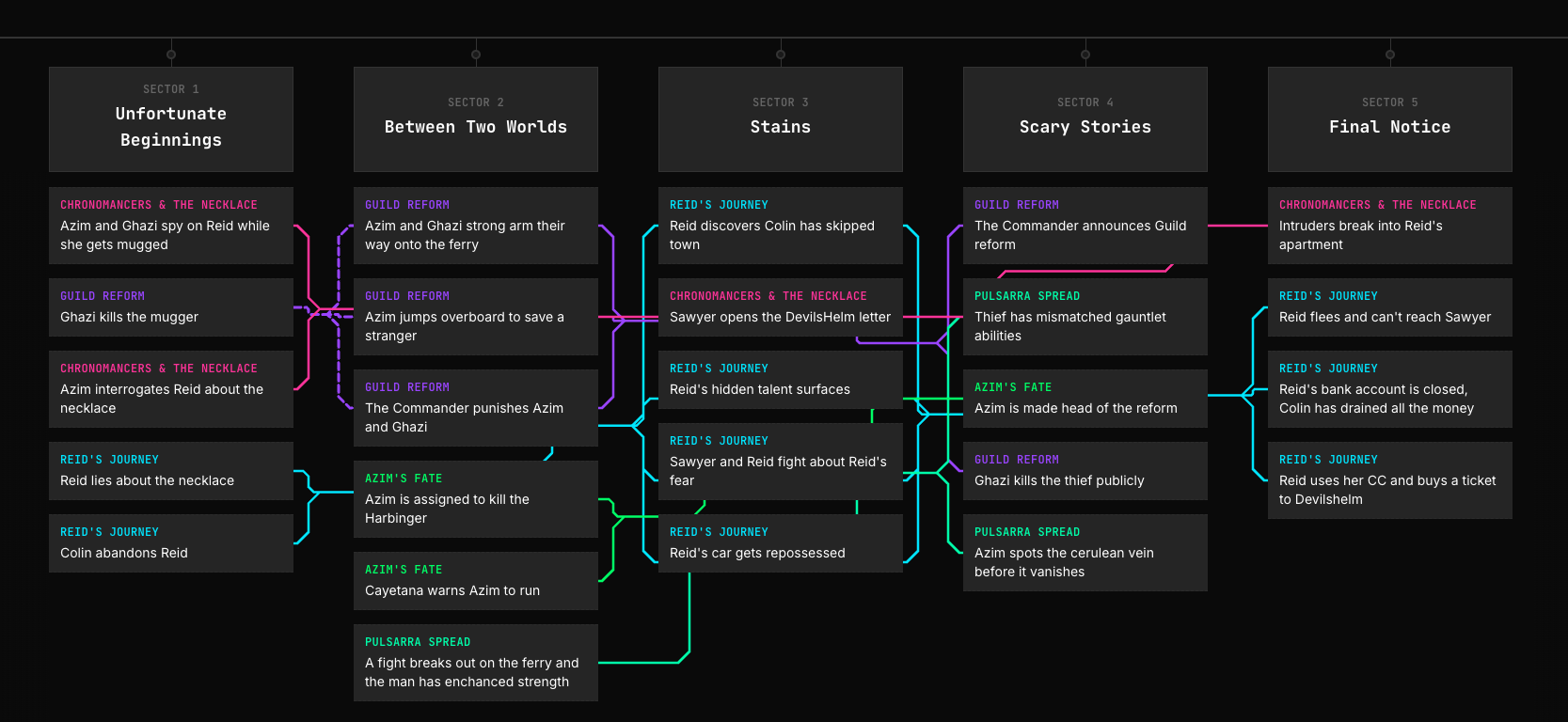
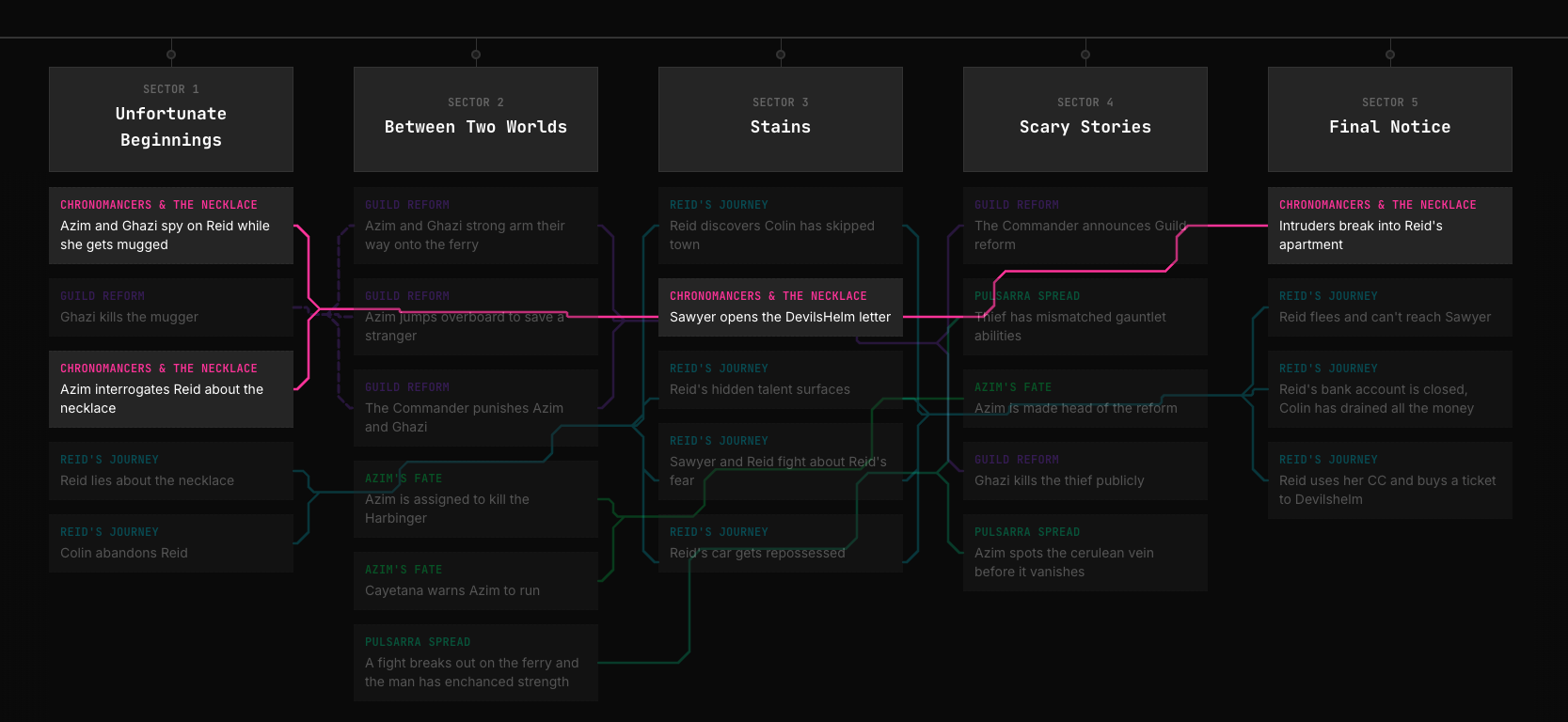
For the first time, I wasn't looking at my story as a wall of text or a flat spreadsheet. Chapters hung from the wire. Beats stacked beneath them. Colored threads connected the plotlines across the timeline — a woven thing, not a list.
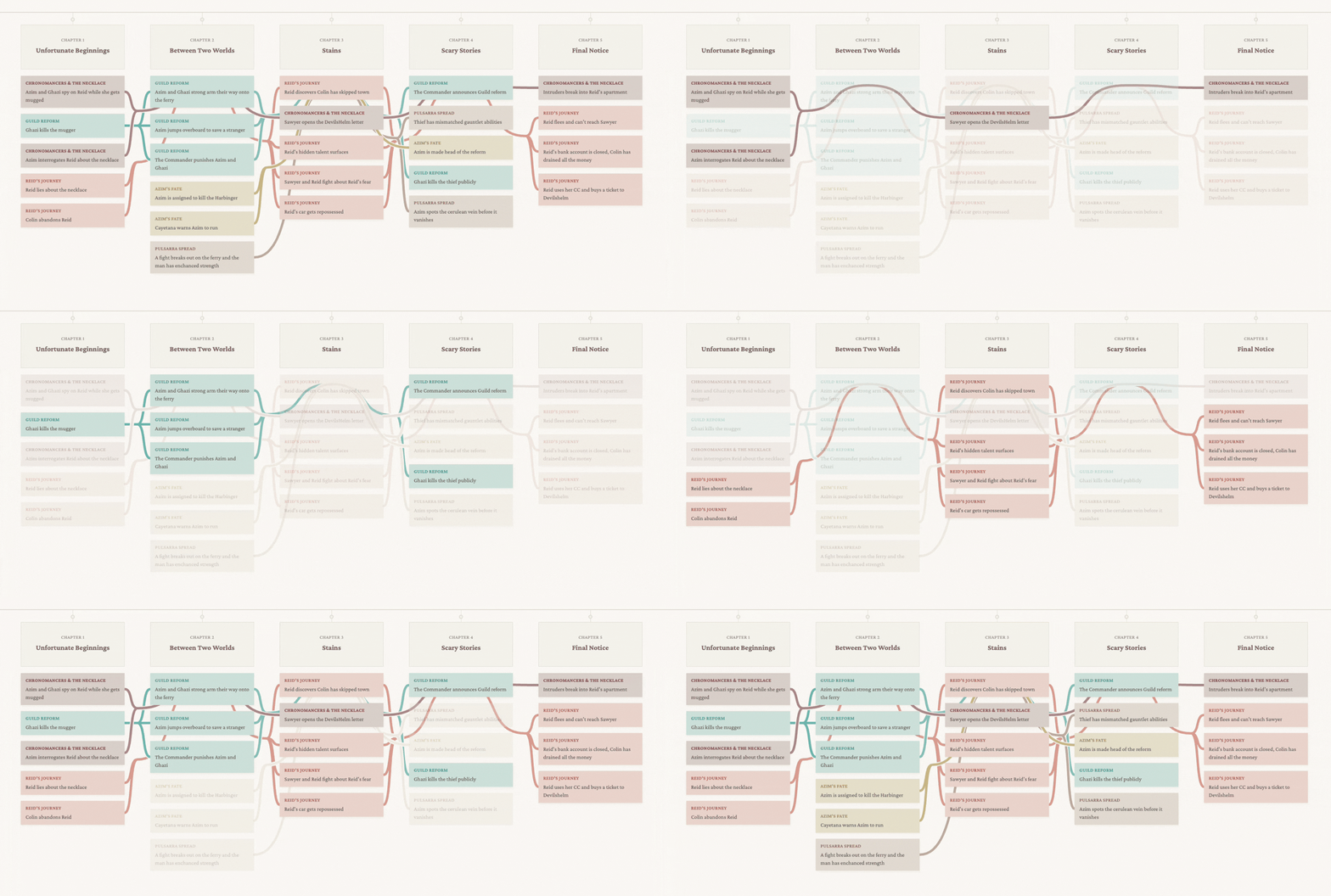
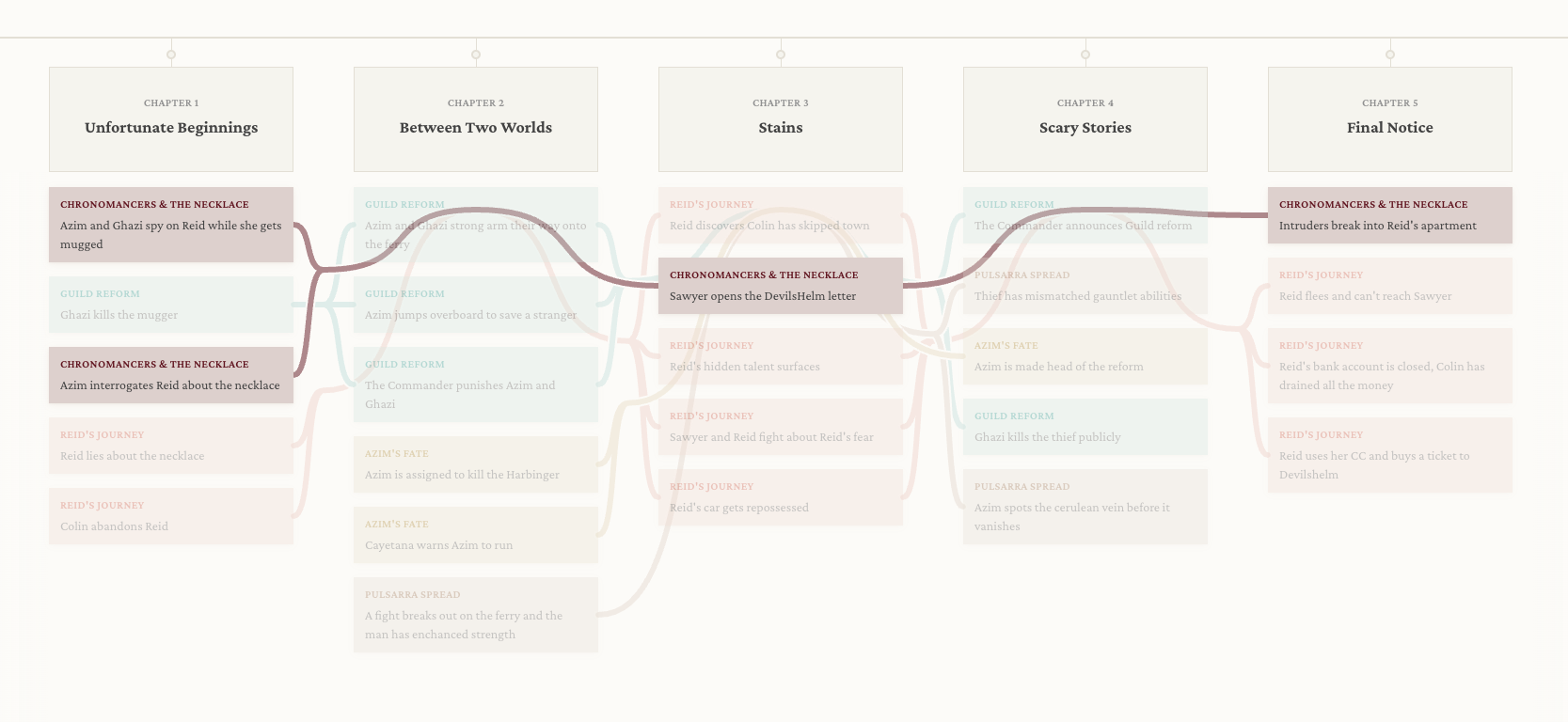
The rest of the application dimmed. One pink thread, the Chronomancers & the Necklace plotline, came into focus, and I could trace it from Chapter 1 all the way to Chapter 6 and beyond. I could see where it surfaced, where it went quiet, where the gaps were. If I'd had this a year ago, I never would have lost Torvyn (RIP, He isn't dead but perhaps he should be!). The silence of his missing arc would have been obvious on the wire.
I thought that was the breakthrough.
It wasn't. It was the entrance to a much bigger maze.
The Rooms in the Labyrinth
As I tagged my chapters, I realized beats are not created equal.
In the prologue, I open with Azim who has obsidian dripping down his hand, he's going to morph it into his gauntlet. That's not an action. That's me telling the reader this is not a normal world. It's a worldbuilding seed.
Later, I tag the color of Azim's gauntlet because I need to remember it in Book 3. That's continuity. It belongs in the Wiki.
Then there's a scene where Ghazi and Azim watch Reid get mugged and don't interfere. On paper, it's just dialogue. But structurally, it's a promise. I am telling the reader that Ghazi and Azim are punks and mildly dangerous — that these are people who watch violence happen and choose not to stop it. If Ghazi goes three books without acting on that darkness, it can't be an accident. It has to be a deliberate, high-tension choice. That's not a plot beat. That's a narrative flag I've planted, and the story has to honor it.
And then Reid lies during an interrogation. The lie itself is a beat, sure. But what matters more is what the lie sets off — the cascade of consequences that ripple outward from that single moment. In fact, perhaps had she given him the damn necklace, the rest of the entire series… would have never happened.
“These aren't bullet points on a timeline. They're different species of structural knowledge.”
A worldbuilding seed. A continuity thread. A promise to the reader. A catalyst. Each one needs to be extracted and visualized in completely different ways, because each one means something different to the architecture of the story.
I had built the function of collecting data. Tagging a beat is easy. But I hadn't done the architectural heavy lifting to understand what happens after the tag. How to bridge the gap between the action of marking something and the visualization that makes it useful. The Clothesline shows you where your beats land. It doesn't yet know what kind of knowledge they carry.
Many tools try to solve this with AI. An oracle that interprets your story for you. That's not what this is.
“aampersand is a mirror.”
It collects your data and reflects it back so you can see the shape of what you've built and make your own decisions.
Wax Coated Feathers
People remember Daedalus for the wings. They forget he was trapped in the labyrinth right alongside Icarus. The labyrinth he built. The wings weren't a victory lap. They were a survival mechanism, built by a man standing inside the walls of his own creation.
I spent March confused in the pits of hell. The Clothesline works. It showed me the view from above. But it also showed me how deep the maze actually goes.
Daedalus did not perish in the labyrinth. Neither will I. And if I make it out… well, perhaps I will take a vacation to the beach and wonder what kind of transformations await me.
find the way out
I spent March lost in a labyrinth of my own design. If you're writing something sprawling enough to get lost in — plotlines that loop, promises buried three chapters deep, arcs that go silent when you're not watching, I'm building the thing that shows you the view from above.
Next month: Pondering a shipwreck.